Anterior and posterior colporrhaphy
Native tissue repair of the anterior and posterior vaginal walls by midline plication of the fibromuscular layer, with perineorrhaphy where the perineal body is deficient. Anterior wall prolapse usually comes with apical prolapse, so the apex is assessed and supported at the same time. Mesh adds little and has no role in the posterior wall.
Draft guide, awaiting specialist review. Check against your unit's protocol.
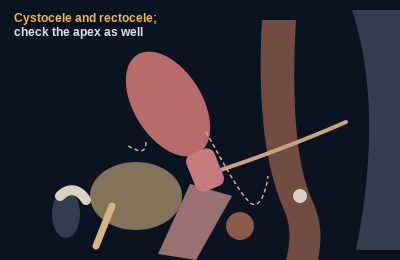
Assess every compartment
Examine the anterior wall, apex and posterior wall while the woman strains, and ask about voiding, defecation and sexual function. Anterior prolapse usually comes with apical descent, so plan an apical procedure as well. Remember that bowel and bladder symptoms have many causes and may not all resolve with repair.
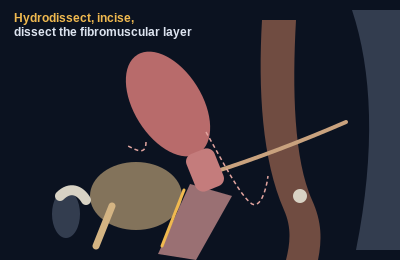
Anterior repair: open and dissect
Mark the extent of the bulge with Allis clamps, inject for hydrodissection and haemostasis, and incise the vaginal epithelium in the midline. Dissect the fibromuscular layer off the epithelium on each side.
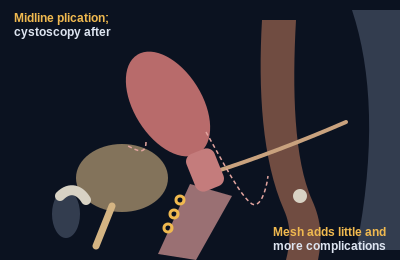
Plicate and check the bladder
Plicate the fibromuscular layer in the midline with interrupted delayed absorbable sutures to reduce the bulge (a paravaginal repair reattaches lateral defects to the arcus tendineus). Trim and close the epithelium. Perform cystoscopy to confirm bladder and ureteric integrity.
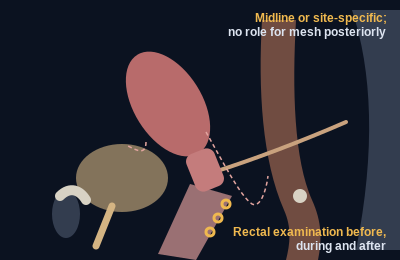
Posterior repair
Mark, inject and incise the posterior wall, and dissect the rectovaginal fibromuscular layer off the epithelium. Reduce the rectocele by midline plication or by repairing specific defects, guided by a finger in the rectum. Trim excess epithelium and close.
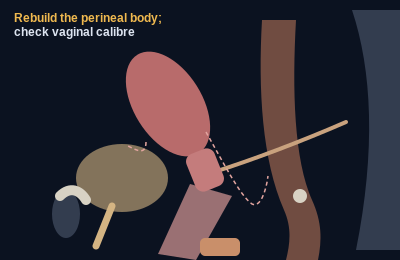
Perineorrhaphy and checks
Rebuild the perineal body with two or three wide interrupted sutures through the superficial and deep transverse perineal and bulbocavernosus muscles. Check vaginal calibre digitally and do a final rectal examination to confirm the rectum is intact.
Indications
- Symptomatic anterior wall prolapse (bulge, voiding difficulty, splinting)
- Symptomatic posterior wall prolapse (bulge, obstructed defecation, splinting)
- A deficient perineal body (perineorrhaphy)
Contraindications
- Isolated wall repair when the apex also needs support
- Asymptomatic prolapse; women who prefer a pessary
Consent: points to cover
- Bulge symptoms may persist or recur (success for the anterior wall is variable)
- Bladder or rectal injury; bleeding; infection
- Urinary symptoms may not resolve; stress incontinence may appear
- Dyspareunia and narrowing of the vagina, especially after posterior repair
Equipment
- Allis clamps, Metzenbaum scissors, dilute vasopressin or lignocaine with adrenaline
- Delayed absorbable sutures for plication and perineorrhaphy
- Cystoscope
Complications
- Recurrence (especially anterior)
- Bladder or ureteric injury (anterior), rectal injury (posterior)
- Dyspareunia, vaginal narrowing
- Voiding dysfunction or de novo stress incontinence
Exam pearls
- Anterior wall prolapse usually comes with apical prolapse: assess and support the apex
- Cystoscopy after anterior repair to confirm bladder and ureteric integrity
- Mesh gives little advantage with more morbidity anteriorly, and has no role posteriorly
- Transvaginal posterior repair is better than a transanal approach
- Most posterior repairs benefit from a perineorrhaphy
- Rectal examination before, during and before closing a posterior repair