Bartholin cyst and abscess: Word catheter and marsupialisation
A Bartholin abscess or a symptomatic duct cyst needs drainage, and drainage alone often recurs because the opening seals. Creating a permanent track, with a Word catheter left for 4 to 6 weeks or by marsupialisation, lowers recurrence. Both are usually done in the clinic or casualty under local anaesthetic. A solid Bartholin mass, especially after menopause, may be a carcinoma and needs biopsy.
Draft guide, awaiting specialist review. Check against your unit's protocol.
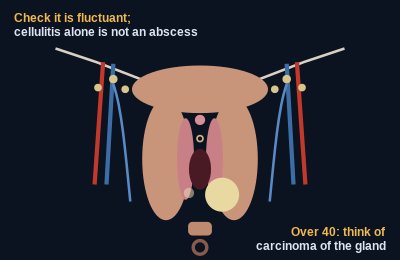
Assess the swelling
A Bartholin cyst or abscess lies in the lower labium at the 4 or 8 o'clock position. Confirm a fluctuant collection: cellulitis alone can look similar, and if no fluctuance is felt an ultrasound helps. A solid mass, particularly in a postmenopausal woman, needs a biopsy because carcinoma of the gland is possible.
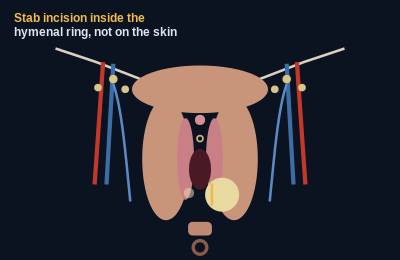
Incise inside the hymenal ring
Clean the area, infiltrate local anaesthetic, and make a short stab incision on the vestibular (inner) side of the swelling, just outside the hymenal ring, rather than on the outer labial skin. Take a swab for culture.
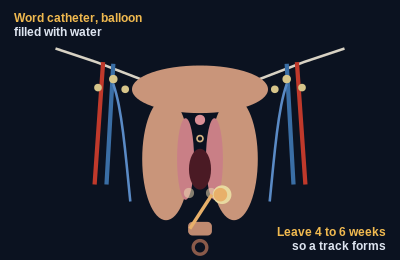
Place the Word catheter
Test the balloon first with sterile water or saline (not air). Deflate it, insert the catheter fully into the cavity, guided with a haemostat, and inflate the balloon with 2 to 3 mL so it stays in. Tuck the free end into the vagina.
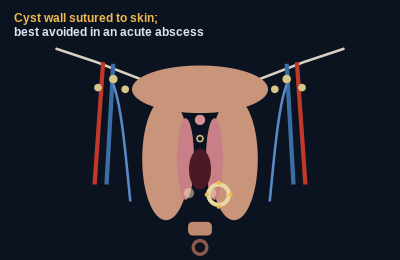
Or marsupialise
For recurrent cysts, excise an ellipse of vestibular skin over the cyst, open the cyst wall, and suture the cyst lining to the surrounding skin all round with fine absorbable sutures, leaving a permanent opening. This suits an uninfected cyst and can be done under local or regional anaesthesia.
Aftercare
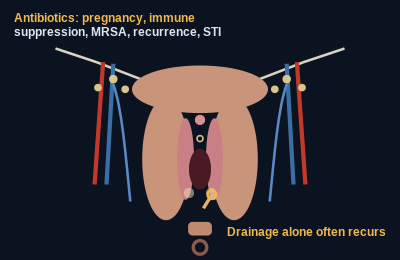
Leave the Word catheter for 4 to 6 weeks so that an epithelium-lined track forms; then deflate and remove it. Give antibiotics only for pregnancy, immune suppression, MRSA, recurrent abscess, or concurrent gonorrhoea or chlamydia. Sitz baths help comfort.
Indications
- Bartholin gland abscess (painful, fluctuant)
- Symptomatic duct cyst: pressure, dyspareunia, difficulty walking
- Marsupialisation: recurrent cysts or abscesses after previous drainage
Contraindications
- No fluid collection (cellulitis alone): treat medically, and image if unsure
- Marsupialisation in an acute abscess or inflamed tissue (the opening tends to close early)
- A solid mass: biopsy rather than drain
Consent: points to cover
- Pain relief and drainage; catheter stays 4 to 6 weeks
- Recurrence, especially if the catheter falls out early
- Bleeding or haematoma (uncommon)
- Return if fever, increasing pain or the catheter falls out
Equipment
- Antiseptic, 1% lignocaine with adrenaline, 25 G needle
- No. 11 blade, haemostat, swab for culture
- Word catheter and 3 mL syringe with sterile water or saline
- For marsupialisation: Allis clamps, fine absorbable suture (e.g. polyglactin)
Complications
- Recurrence (higher with drainage alone)
- Premature closure of the track; catheter expelled early
- Bleeding or haematoma if the incision is too deep or there is no collection
- Missed carcinoma in a solid or postmenopausal mass
Exam pearls
- Most minor vulval procedures can be done safely in the clinic
- Have a low threshold to biopsy a lesion of uncertain cause or one that has changed
- Create a fistula track at drainage, with a Word catheter or marsupialisation, to reduce recurrence
- Leave the Word catheter 4 to 6 weeks
- Antibiotics for pregnancy, immune suppression, MRSA, recurrence or concurrent gonorrhoea or chlamydia
- Bartholin carcinoma is 5% of vulval cancers: think of it with a solid mass, especially after menopause