Bowel injury at gynaecological surgery
Bowel injuries during gynaecological surgery range from a serosal tear to full-thickness lacerations and thermal burns. Recognising them at the time is what matters most. Small bowel lacerations are closed across the bowel so the lumen is not narrowed; thermal injuries extend beyond what is visible and need oversewing or excision with a margin; multiple or extensive injuries are best resected with one anastomosis of healthy, tension-free bowel.
Draft guide, awaiting specialist review. Check against your unit's protocol.
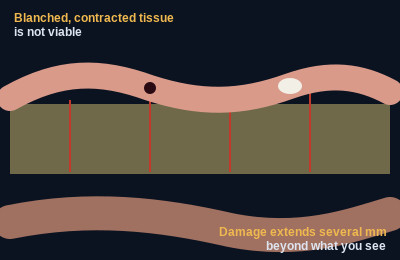
Recognise the injury
Look for bowel contents, a hole, or a blanched, contracted patch after diathermy. Thermal damage extends several millimetres beyond what is seen, and monopolar injuries can occur away from the instrument tip.
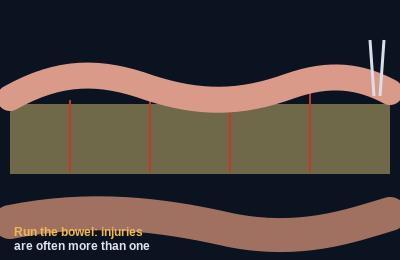
Run the bowel
Run the whole small bowel from the ileocaecal junction to the duodenojejunal flexure between atraumatic graspers, inspecting both sides of each loop and the mesentery. One injury is often accompanied by another.
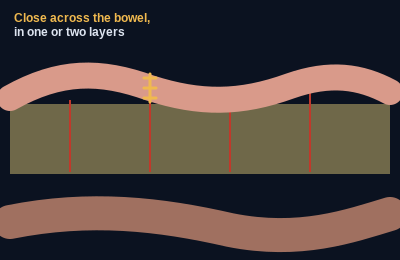
Repair a laceration across the bowel
Close a full-thickness small bowel laceration in one or two layers with fine delayed absorbable sutures, with the line of closure perpendicular to the long axis of the bowel so the lumen is not narrowed. This matters less in the wide colon. A seromuscular tear is closed with inverting seromuscular sutures.
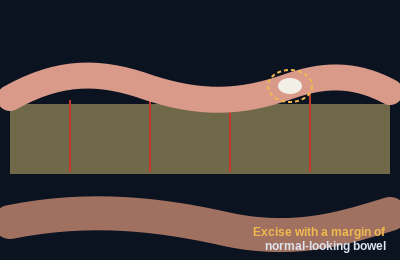
Deal with thermal injury
A small superficial burn seen by the surgeon may need nothing, or inverting seromuscular sutures. A more substantial burn needs at least excision of the seromuscular layer, including a margin of normal-looking bowel, and repair; extensive damage needs resection.
Resect when needed
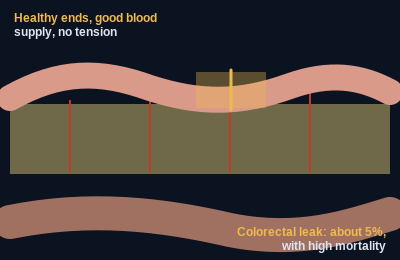
For several injuries close together, devascularised bowel or extensive burns, resect the segment and join healthy, well-perfused ends without tension in a single anastomosis (hand-sewn or stapled). After a colorectal anastomosis at high risk of leak, consider a diverting stoma.
Indications
- Recognised serosal, seromuscular or full-thickness bowel injury
- Thermal (diathermy) injury
- Multiple injuries close together or devascularised bowel
Contraindications
- A limited superficial burn seen by the surgeon generally needs no treatment
- Call a general or colorectal surgeon early when injuries are beyond your experience
Consent: points to cover
- Bowel injury is a recognised risk of pelvic surgery, especially with adhesions
- Repair, resection or (rarely) a stoma
- Longer stay, delayed feeding, infection, leak
Equipment
- Atraumatic bowel clamps (Babcock), fine delayed absorbable sutures
- Linear and circular staplers
- Warm saline, suction
Complications
- Delayed perforation from unrecognised thermal injury
- Anastomotic leak (about 5% for colorectal, with 10 to 30% mortality)
- Stricture; short bowel after extensive resection
- Intra-abdominal abscess
Exam pearls
- Blanched, contracted tissue is not viable; damage extends several mm beyond the visible injury
- Repair small bowel lacerations perpendicular to the lumen to avoid narrowing
- A small superficial burn may need no treatment, or inverting seromuscular sutures
- Larger burns need at least seromuscular excision with a normal margin and repair
- Bowel to be anastomosed must be healthy, well perfused and without tension
- Colorectal anastomotic leak: about 5%, mortality 10 to 30%; consider a diverting stoma
- Bowel obstruction in recurrent ovarian cancer with ascites and bulky tumour: medical management