Controlling haemorrhage during pelvic surgery
Sudden heavy bleeding happens to every surgeon. The first move is always pressure; the next is to tell the team, get help and blood, and only then go back with exposure, suction and the right instrument. Arteries are clamped and tied; large veins are held, not burned. When local measures fail, tie the anterior division of the internal iliac arteries, pack and come back, or embolise.
Draft guide, awaiting specialist review. Check against your unit's protocol.
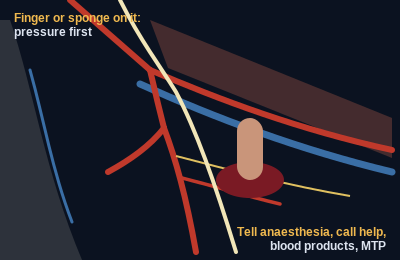
Pressure, then stop and plan
Put a finger or a sponge on the bleeding point at once. Suction the field and decide: if you can see the vessel, roll the finger off with a fine clamp ready. If not, keep the pressure on and step back. Tell the anaesthetist and the theatre team, check blood loss and access, call for help and blood products, and activate the massive transfusion protocol if needed. Ten minutes of pressure often reduces the bleeding a great deal.
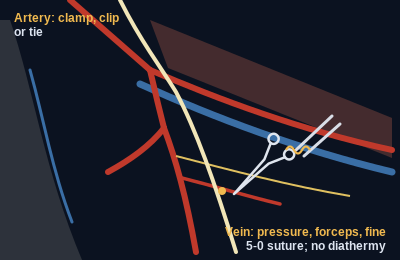
Artery or vein: different tactics
Arterial bleeding spurts; the thick wall holds a clamp, clip or tie, and a retracted end can be grasped and twisted before tying. Venous bleeding is harder: pelvic veins are thin, tortuous and fed from several directions. Hold pressure for at least 5 minutes, then control the tear with DeBakey forceps and close it with a clip or a fine 5-0 monofilament suture without narrowing the vein.
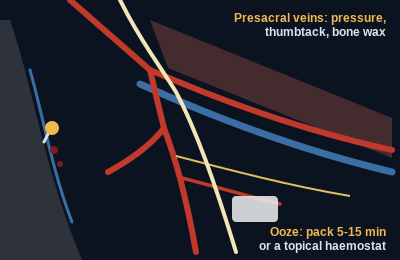
Oozing surfaces and the presacral space
Diffuse oozing after adhesiolysis or cancer surgery usually stops with diathermy or a pack held for 5 to 15 minutes. If not, apply a topical haemostat: oxidised cellulose or gelatin sponge under pressure, thrombin, a flowable matrix or fibrin sealant. Presacral or sacral foraminal venous bleeding can kill: pressure first, then sterile thumbtacks pushed into the sacrum, layered gelatin and collagen held under a pack, or bone wax.
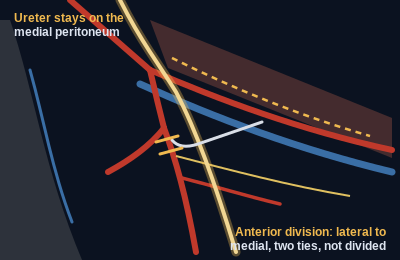
Tie the anterior division of the internal iliac
Open the peritoneum over the external iliac artery from the round ligament to the infundibulopelvic ligament. Follow the internal iliac up to the bifurcation, leaving the ureter attached to the medial peritoneum. Identify the posterior division. About 2 cm beyond the bifurcation, pass a nonabsorbable tie around the anterior division with a right-angle clamp from lateral to medial, and place a second tie distal to it. Do not divide the artery. Tie both sides, and add ovarian vessel ligation if the uterus is kept.
Pack, return or embolise
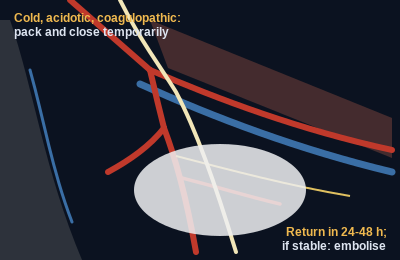
If bleeding continues in an unstable, cold or coagulopathic patient, stop operating: pack the pelvis firmly, close temporarily (for example a Bogota bag or a negative pressure dressing) and correct volume, clotting, temperature and acidosis in ICU. Return in 24 to 48 hours to remove the packs. A stable patient who rebleeds after surgery is best treated by angiographic embolisation if an interventional radiologist is available.
Indications
- Unexpected haemorrhage at abdominal, laparoscopic or vaginal gynaecological surgery
- Pelvic bleeding not controlled by clamps, ties or clips at the bleeding point
- Diffuse oozing after adhesiolysis, endometriosis or cancer surgery
Contraindications
- Blind clamping or deep stitching in a pool of blood (the ureter, bladder, iliac vessels and nerves are close)
- Diathermy on a tear in a large vein: it enlarges the hole
- Ligating the common or external iliac artery: these are repaired, never tied
Consent: points to cover
- Before surgery, discuss transfusion, its risks (febrile reaction about 1 in 100, HIV about 1 in 2 million) and alternatives
- The possibility of hysterectomy, packing with a return to theatre, further surgery or embolisation
- Record in advance a refusal of blood (e.g. a Jehovah's Witness) and her wishes about cell salvage
Equipment
- Two working suctions, good light (headlight) and a self-retaining retractor
- Long fine clamps, right-angle clamp, DeBakey forceps, clip applier
- 5-0 monofilament vascular sutures on a small needle; nonabsorbable ties
- Topical haemostats (oxidised cellulose, gelatin sponge, thrombin, fibrin sealant), bone wax, sterile thumbtacks
- Blood bank alerted; massive transfusion protocol
Complications
- Hypovolaemic shock with coagulopathy, hypothermia and acidosis (the lethal triad)
- Ureteric, bladder or nerve injury from hurried clamping
- Transfusion reactions, circulatory overload (TACO) and lung injury (TRALI)
- Abdominal compartment syndrome after packing
- Pelvic haematoma and infection after surgery
Exam pearls
- Finger or sponge pressure first, then stop and plan
- Tell the anaesthetist; call for help, extra suction and senior, oncology or vascular support; activate the massive transfusion protocol early
- Artery: clamp, clip or tie. Vein: pressure for at least 5 minutes, then forceps and a fine 5-0 suture
- Keep her warm and avoid acidosis: both stop clotting
- Consider transfusion when loss passes 15% of blood volume (weight in kg x 10 mL)
- Internal iliac ligation: anterior division, distal to the posterior division, about 2 cm from the bifurcation, passed lateral to medial, tied twice, not divided; leave the ureter on the medial peritoneum
- Presacral bleeding: pressure, then sterile thumbtacks, bone wax or layered haemostats
- Unstable with ongoing bleeding: pack, close temporarily and return in 24 to 48 hours; embolise if stable