Genital injury in girls and vaginoscopy
Genital injuries in girls are mostly accidental, with straddle injuries the commonest, but abuse must always be considered. The unoestrogenised tissues bleed readily. After resuscitation, the history is checked against the injury. Girls who can void, have minimal bleeding and can be fully examined are managed conservatively; others need examination under anaesthesia with vaginoscopy and repair, with urology or surgery when deeper structures are involved. In South Africa, suspected abuse of a child must be reported.
Draft guide, awaiting specialist review. Check against your unit's protocol.
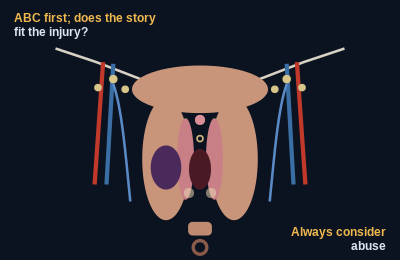
Resuscitate and take the history
Check airway, breathing and circulation first. Take a careful history, with a witness if possible, and ask whether it fits the injury. Straddle injuries are the commonest; other causes include falls, accidents, bites, burns, high-pressure water and abuse.
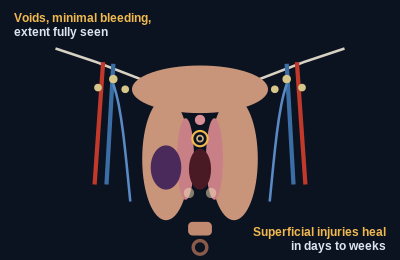
Decide on conservative care
Manage conservatively if she can void, bleeding is minimal and the full extent of the injury has been seen. Bruises, abrasions, small haematomas and superficial lacerations heal within days to weeks without scarring.
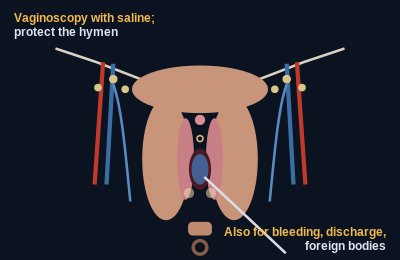
EUA with vaginoscopy
When she cannot be fully examined awake, or there is bleeding from within the vagina, examine under anaesthesia. Pass a small vaginoscope without damaging the hymen, compress the vulva around it and fill the vagina with saline to see the whole canal and the cervix.
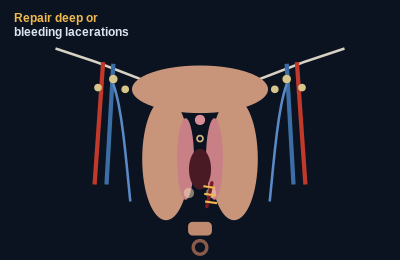
Repair
Repair deep or bleeding lacerations with fine absorbable sutures, and drain an expanding haematoma if needed.
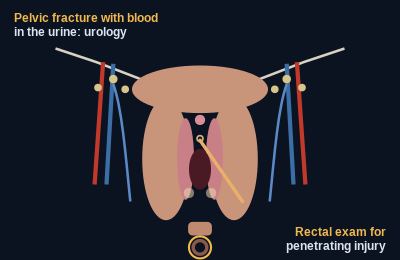
Look for deeper injury
Catheterise or perform cystoscopy if urethral or bladder injury is suspected, especially with a pelvic fracture and haematuria. A penetrating injury needs a rectal examination for the perineal body, anus and sphincter. Involve urology, surgery or orthopaedics as needed, follow up to check healing, and report suspected abuse.
Indications
- EUA and vaginoscopy: bleeding, persistent discharge, injury beyond the hymen, suspected foreign body, congenital conditions
- Repair: deep or bleeding lacerations, expanding haematoma
Contraindications
- Superficial abrasions, bruising and small lacerations that heal on their own
- Examining a frightened child forcibly while awake
Consent: points to cover
- Parent or guardian, with the child's assent; a child of 12 or older with enough maturity consents herself (Children's Act)
- Possible repair, catheter, involvement of other specialists
- Mandatory reporting of suspected abuse (Children's Act s110; Sexual Offences Act s54)
Equipment
- Vaginoscope (small cystoscope or hysteroscope), saline
- Fine absorbable sutures
- Catheter, cystoscope; forensic evidence kit if abuse suspected
Complications
- Missed urethral, bladder, rectal or sphincter injury
- Haematoma, infection
- Missed abuse
Exam pearls
- Straddle injuries are commonest; abuse must always be considered
- Unoestrogenised tissue is very vascular and bleeds freely
- Conservative management needs: able to void, minimal bleeding, extent fully assessed
- EUA with vaginoscopy (saline distension, protect the hymen) assesses the upper vagina and cervix
- Catheterisation or cystoscopy for suspected urological injury; pelvic fracture with haematuria suggests it
- Rectal examination for penetrating injury; involve urology, surgery or orthopaedics