Hysteroscopic resection of a uterine septum
A septate uterus is a cause of recurrent pregnancy loss. The septum, partial or complete, is removed hysteroscopically with scissors or energy, which improves pregnancy outcomes and is well tolerated. An arcuate uterus (fundal indentation under 1 cm) is a normal variant and needs no surgery, and unification of didelphys or bicornuate uteri does not help.
Draft guide, awaiting specialist review. Check against your unit's protocol.
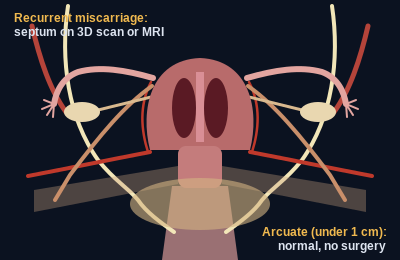
Confirm a septum, not a bicornuate uterus
In a woman with recurrent miscarriage, 3D ultrasound or MRI distinguishes a septate uterus (smooth outer fundus, internal septum) from a bicornuate uterus (fundal cleft externally). An indentation under 1 cm is an arcuate uterus, a normal variant.
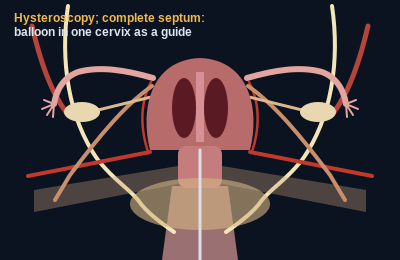
Hysteroscopy
Place a Foley catheter, then perform diagnostic hysteroscopy to define the septum's margins. With a complete septum and two cervices, a Foley balloon in one cervix helps identify the septal margins.
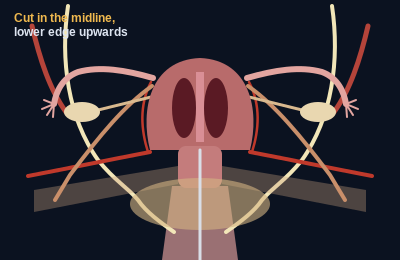
Divide the septum
Cut the septum in the midline from its lower edge upwards with hysteroscopic scissors or an energy device, keeping equidistant from the front and back walls.
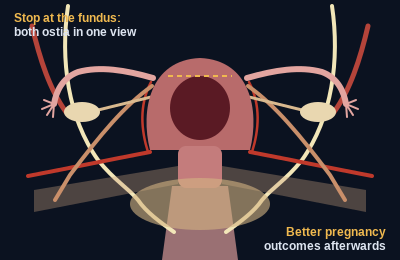
Stop at the fundus
Stop when the cavity is a single space at the level of the fundus, with both tubal openings seen in one view. Removing the septum improves pregnancy outcomes.
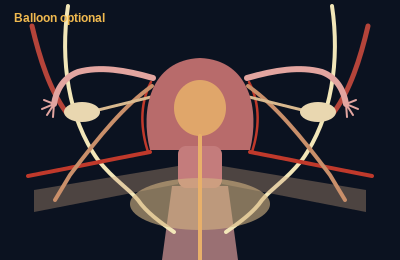
Afterwards
An intrauterine balloon may be left for a short time, but is optional. Plan pregnancy after the cavity heals.
Indications
- Septate uterus with recurrent pregnancy loss or other adverse obstetric history
Contraindications
- Arcuate uterus (under 1 cm): normal variant
- Bicornuate or didelphys uterus: the fundus is divided externally, so hysteroscopic resection is wrong and unification does not improve outcomes
Consent: points to cover
- Perforation, bleeding, fluid overload
- Intrauterine adhesions
- Improved pregnancy outcomes expected
Equipment
- Operative hysteroscope, scissors or energy device
- Foley catheter; a second Foley balloon for a complete septum with two cervices
- Optional intrauterine balloon afterwards
Complications
- Perforation at the fundus
- Fluid overload
- Adhesions
Exam pearls
- Septate uterus is associated with recurrent pregnancy loss
- Hysteroscopic removal with scissors or a cautery device improves pregnancy outcomes
- A complete septum with two cervices: a Foley balloon in one cervix helps identify the septal margins
- An intrauterine balloon afterwards is optional
- Arcuate uterus (under 1 cm): normal, no surgery