Imperforate hymen: hymenectomy
Imperforate hymen is the commonest obstructive anomaly of the vagina. A newborn may have a bulge from mucocolpos that settles on its own; an adolescent presents with cyclic pain and no periods, from haematocolpos. Repair is best after breast development has begun but ideally before menarche, after imaging confirms the diagnosis. The membrane is excised, not just cut, and its edge sewn.
Draft guide, awaiting specialist review. Check against your unit's protocol.
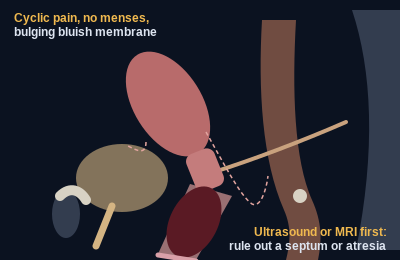
Recognise and image
An adolescent with cyclic pelvic pain, no menses and a bulging, bluish membrane at the introitus has an imperforate hymen until proved otherwise. Confirm with pelvic ultrasound or MRI, which also excludes a transverse septum or vaginal atresia and checks the uterus and kidneys.
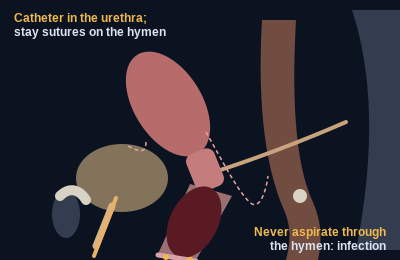
Prepare: catheter and stay sutures
Under general anaesthesia in high lithotomy, place a Foley catheter to identify the urethra. If the bulge is not obvious, gentle pressure on the fundus through the abdomen brings it forward. Place stay sutures on the hymen either side of the planned incision.
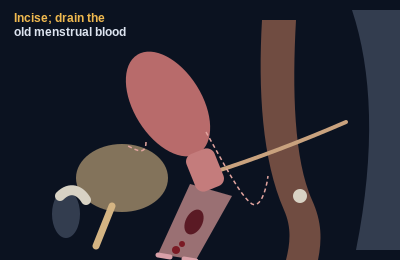
Incise and drain
Incise the hymen with diathermy or a scalpel. If menarche has occurred there is often a large volume of thick old blood, which blocks suction tubing, so have more than one sucker ready.
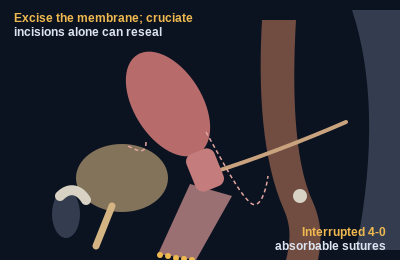
Excise and sew the edge
Excise the hymenal tissue so the opening easily admits a finger, rather than relying on a cruciate or stellate incision alone, which can close again. Sew the hymenal ring with interrupted 4-0 absorbable sutures for haemostasis and to prevent scarring, and infiltrate local anaesthetic.
Timing and aftercare
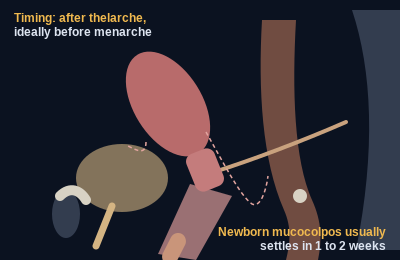
Elective repair is best once thelarche is established, because oestrogen helps healing, and ideally before menarche. Neonatal mucocolpos usually settles in 1 to 2 weeks without treatment. Afterwards, reassure the girl and her family about normal periods, tampon use and sexual function.
Indications
- Imperforate hymen with haematocolpos (cyclic pain, amenorrhoea, bulging membrane)
- Microperforate or septate hymen limiting menstrual flow or tampon use
- Neonatal mucocolpos causing urinary retention (rare reason to operate early)
Contraindications
- Neonatal mucocolpos without retention: wait, it settles in 1 to 2 weeks
- Uncertain diagnosis: image first to exclude transverse septum or vaginal atresia
- Never aspirate through the hymen (ascending infection)
Consent: points to cover
- Consent from a parent or guardian, with the girl's own assent; in South Africa a child of 12 or older with enough maturity consents to surgery herself, assisted by a parent or guardian (Children's Act)
- Bleeding, infection, scarring or narrowing
- Reassurance about future menstruation, tampon use and sexual function
Equipment
- General anaesthesia, high lithotomy
- Foley catheter for the urethra
- Stay sutures, diathermy or scalpel, two suction devices
- 4-0 absorbable sutures; local anaesthetic for pain relief
Complications
- Re-closure if only a cruciate incision is made
- Bleeding, infection
- Urethral injury (avoided with a catheter)
- Untreated: haematometra, retrograde menstruation, endometriosis and adhesions
Exam pearls
- Commonest obstructive vaginal anomaly (1 in 1,000 to 1 in 10,000)
- Neonatal mucocolpos usually settles in 1 to 2 weeks
- Operate after thelarche is established, ideally before menarche
- Ultrasound or MRI first to confirm the diagnosis and the Mullerian and renal anatomy
- Do not aspirate through the hymen
- Excise the hymenal tissue so the opening admits a finger; suture the edge with interrupted 4-0 absorbable