Laparoscopic ovarian cystectomy and torsion
Most benign adnexal surgery is done laparoscopically. In a woman who wants to keep her ovary, the cyst is shelled out and the ovary conserved, with as little thermal damage as possible to protect ovarian reserve. Torsion needs urgent laparoscopy, and the ovary is untwisted and kept unless it is clearly necrotic.
Draft guide, awaiting specialist review. Check against your unit's protocol.
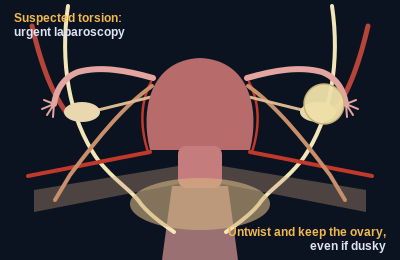
Torsion: untwist and keep the ovary
When torsion is suspected, go to laparoscopy urgently. Untwist the adnexa with atraumatic graspers. In a premenopausal woman without suspicion of malignancy, keep the ovary even if it looks dark and swollen, unless it is grossly necrotic; it often regains function. The cyst can be removed now or later.
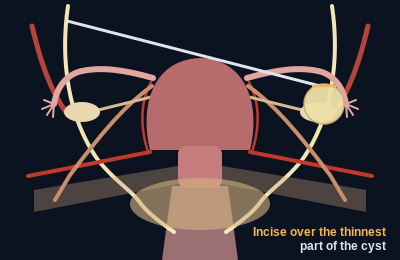
Incise over the cyst
Expose the ovary and note where the cyst lies relative to the hilum, the vessels and the tube. Incise the cortex over the thinnest part of the cyst, at least 1 to 2 cm long, with minimal energy and away from normal cortex.
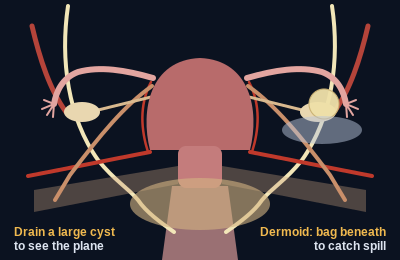
Contain and drain
For a dermoid, place a containment bag under the ovary before opening the cyst, so any spill is caught; try to keep the cyst intact. Large cysts can be drained in a controlled way to make the dissection easier.
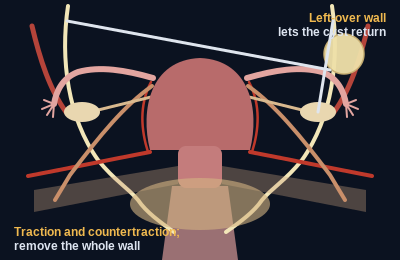
Strip the cyst wall
Grasp the cyst wall and the ovarian edge and peel them apart with gentle traction and countertraction along the cleavage plane, using scissors where it is scarred (as with endometriomas). Inspect the bed to make sure the whole wall has come away.
Haemostasis and removal
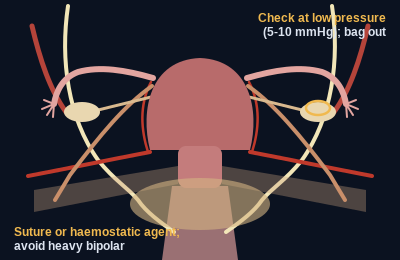
Control bleeding with haemostatic agents or a few absorbable sutures (2-0 or 3-0, interrupted, running or purse-string) rather than extensive bipolar coagulation. Lower the gas pressure to 5 to 10 mmHg to reveal venous bleeding. Remove the cyst in a bag through a port.
Indications
- Persistent benign-looking cysts: dermoid, endometrioma, cystadenoma
- Suspected torsion (acute pain, nausea, an adnexal mass, especially over 5 cm)
- Ruptured cyst with significant haemoperitoneum
Contraindications
- Significant suspicion of malignancy: cystectomy risks spill and upstaging; refer for oophorectomy and staging
- Postmenopausal women with a complex mass: oophorectomy rather than cystectomy
Consent: points to cover
- Removal of the cyst with the ovary kept; oophorectomy if the ovary cannot be saved or there is unexpected malignancy
- Risks: bleeding, conversion, injury to bowel, bladder or ureter, reduced ovarian reserve, recurrence
- Spill of dermoid contents can cause chemical peritonitis
- Torsion: the ovary is untwisted and kept even if dark, as it often recovers
Equipment
- Laparoscopy set with atraumatic graspers, scissors, suction-irrigation
- Containment bag for dermoids; specimen bag for extraction
- Haemostatic agents (oxidised cellulose, gelatin-thrombin) and 2-0 or 3-0 absorbable suture
- Pelvic washings if malignancy is a possibility
Complications
- Bleeding from the cyst bed
- Loss of ovarian reserve from excessive coagulation
- Recurrence if the cyst wall is left
- Chemical peritonitis after dermoid spill; ovarian remnant after a difficult oophorectomy
Exam pearls
- Torsion: urgent laparoscopy; untwist and conserve the ovary in a premenopausal woman unless grossly necrotic
- Suspicion of malignancy is the main contraindication to cystectomy
- Incise over the thinnest cortex; remove the whole cyst wall to prevent recurrence
- Avoid bipolar desiccation of the bed: it harms ovarian reserve most; use sutures or haemostatic agents
- A low-pressure check (5 to 10 mmHg) reveals venous bleeding
- For oophorectomy, find the ureter first, retroperitoneally if needed; for risk-reducing surgery divide the IP ligament at least 2 cm from the ovary