Manual vacuum aspiration (MVA) for miscarriage and termination
Uterine vacuum aspiration empties the uterus in the first trimester for miscarriage, incomplete abortion or termination of pregnancy. Manual vacuum aspiration (MVA) with a self-locking syringe is as safe and effective as electric suction up to 10 weeks, is cheap and portable, and can be done with a paracervical block in a procedure room.
Draft guide, awaiting specialist review. Check against your unit's protocol.
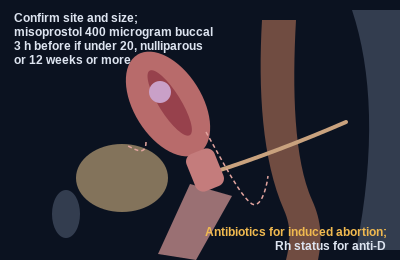
Confirm, counsel and prepare
Confirm an intrauterine pregnancy and estimate its size by examination or ultrasound. Discuss expectant, medical and surgical options. Consider misoprostol 400 microgram buccally 3 hours before for women under 20, nulliparous women or gestations of 12 weeks or more. Give prophylactic antibiotics for a termination, check Rh status, and ask her to empty her bladder.
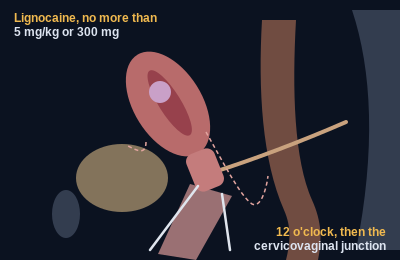
Tenaculum and paracervical block
After a bimanual examination to learn the size and position of the uterus, insert the speculum and clean the cervix. Inject a little lignocaine at 12 o'clock and apply the tenaculum there, then inject at two or more points at the cervicovaginal junction, about 2 to 5 cm deep, keeping the total under 5 mg/kg or 300 mg.
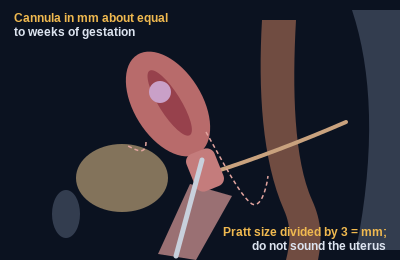
Dilate the cervix
With traction on the tenaculum to straighten the canal, dilate gently with tapered dilators, held by the middle so a sudden give does not plunge the dilator in. Dilate to the size of the planned cannula (about the weeks of gestation in mm). Do not sound the uterus. Keep the tips of everything that enters the uterus untouched.
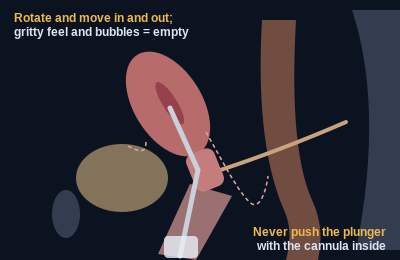
Aspirate
Insert the cannula, attach the charged syringe and open the valves to create the vacuum. Move the cannula in and out with a rotating motion, working mainly in the lower uterus as the contents come down. The uterus is empty when the walls feel gritty, pink froth and bubbles appear, and the uterus contracts on the cannula.
Examine the tissue and aftercare
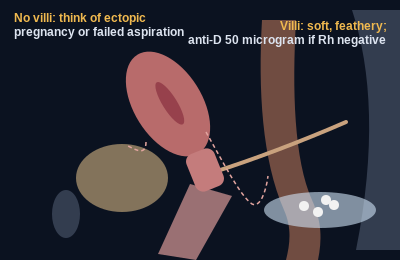
Rinse the aspirate in a strainer and float it in water in a clear dish, backlit: chorionic villi are soft, white and feathery; decidua is coarse. Remove the tenaculum and check for bleeding. Give anti-D 50 microgram to Rh-negative women, offer contraception, and explain when to return.
Indications
- Incomplete or missed miscarriage, when the woman prefers surgery or bleeding is heavy
- Termination of pregnancy in the first trimester (in South Africa, on request up to 12 weeks under the Choice on Termination of Pregnancy Act 92 of 1996)
- Septic incomplete abortion, together with antibiotics
Contraindications
- Suspected ectopic pregnancy until an intrauterine pregnancy is confirmed
- Haemodynamic instability needing resuscitation and theatre
- Gestation beyond the operator's skill or the equipment's range: refer or use dilatation and evacuation with cervical preparation
Consent: points to cover
- Options: expectant, medical (misoprostol, with mifepristone for termination) or surgical management
- Pain relief: paracervical block with or without sedation
- Risks: bleeding, retained tissue (under 1%), infection (under 1 in 100), perforation (about 1 in 1,000), cervical injury, haematometra, need to repeat
- Rh-negative women need anti-D; contraception can start the same day
- A first-trimester aspiration does not cause infertility or ectopic pregnancy
Equipment
- Speculum (short blades help), tenaculum, lignocaine for a paracervical block
- Pratt or tapered dilators; cannulas of 4 to 12 mm; MVA syringe with pinch valves
- Misoprostol for cervical preparation; doxycycline or similar for prophylaxis in termination
- Strainer and clear dish to examine the tissue; anti-D
Complications
- Haemorrhage (atony, cervical laceration, perforation)
- Cervical injury
- Uterine perforation
- Acute haematometra
- Retained tissue, infection, Rh sensitisation
Exam pearls
- Cervical preparation is not routine in the first trimester; consider misoprostol 400 microgram buccally 3 hours before for women under 20, nulliparous women and gestations of 12 weeks or more
- Paracervical block with lignocaine, no more than 5 mg/kg or 300 mg
- Do not sound the uterus; use a no-touch technique
- Cannula diameter in mm is about the weeks of gestation; Pratt size in French divided by 3 gives mm
- Complete when the walls feel gritty, bubbles appear and the uterus contracts; examine the tissue for villi
- No villi: think of ectopic pregnancy, failed aspiration or perforation
- Give antibiotics for termination; anti-D 50 microgram for Rh-negative women in the first trimester