Midurethral sling for stress incontinence
A synthetic midurethral sling is the first-line operation for stress urinary incontinence: highly effective, low in morbidity, and the most studied procedure for it. The tape lies loosely under the midurethra, passed either behind the pubic bone (retropubic) or through the obturator foramen (transobturator). Conservative treatment, especially pelvic floor muscle training, comes first.
Draft guide, awaiting specialist review. Check against your unit's protocol.
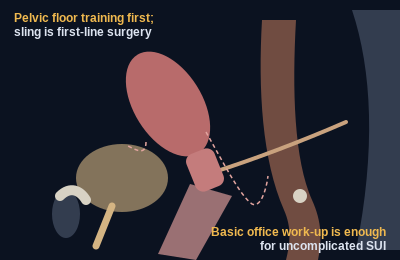
Confirm the diagnosis and treat conservatively first
Confirm stress incontinence objectively (a cough stress test), check the post-void residual and urine, and assess urethral mobility and prolapse. Offer pelvic floor muscle training first. A basic office evaluation is enough for uncomplicated stress incontinence; urodynamics are for complex cases.
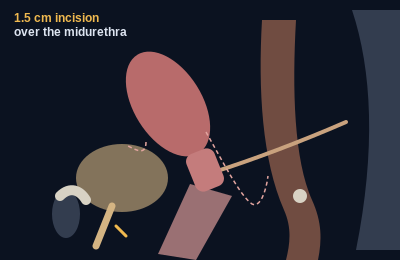
Incision over the midurethra
With the bladder drained, make a 1.5 cm incision in the anterior vaginal wall over the midurethra. Create short tunnels beside the urethra with Metzenbaum scissors towards the pubic bone (retropubic) or the inferior pubic ramus (transobturator).
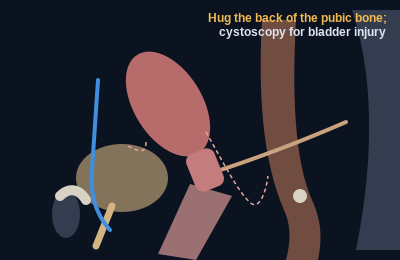
Retropubic passage
Mark exit points 2 cm either side of the midline just above the pubic bone. Deviate the bladder away with a catheter guide. Pass the trocar through the tunnel and into the retropubic space, keeping its tip on the back of the pubic bone by dropping the handle, and out through the suprapubic mark. Repeat on the other side and perform cystoscopy.
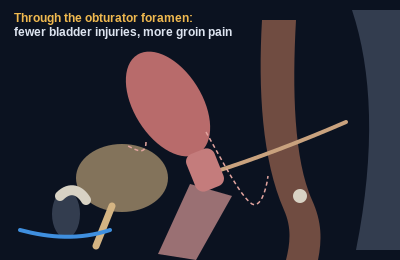
Transobturator alternative
For a transobturator sling, the trocar is passed from the vaginal incision around the inferior pubic ramus, through the obturator membrane, to exit on the medial side of the obturator foramen at the level of the clitoris, then repeated on the other side.
Set the tension and check
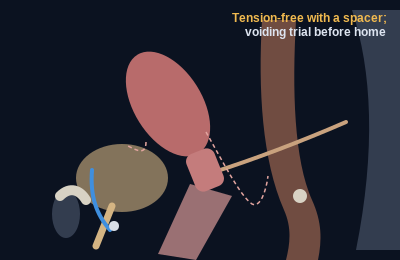
Remove the plastic sheaths with a spacer (such as a size 9 Hegar dilator) between the tape and the urethra, so the tape lies flat without tension. Cystoscopy confirms no bladder or urethral injury. Close the incision and do a voiding trial before discharge.
Indications
- Bothersome stress urinary incontinence, objectively confirmed, after conservative treatment
- Urethral hypermobility
- Women who have completed or are not planning further pregnancy (preferably)
Contraindications
- Predominant urge incontinence or a high post-void residual without assessment
- Untreated urinary tract infection
- Previous failed surgery, prolapse beyond stage II, or voiding dysfunction need fuller (urodynamic) assessment first
Consent: points to cover
- Success is high; alternatives include pelvic floor training, Burch colposuspension, autologous fascial sling and bulking agents
- Bladder perforation (more with retropubic), groin or thigh pain (more with transobturator)
- Voiding difficulty or retention; new urgency
- Mesh exposure in the vagina; dyspareunia
- Safety and effectiveness of mesh midurethral slings are supported by the literature and regulators
Equipment
- Sling kit (retropubic or transobturator) with trocars
- Catheter guide to deviate the bladder; local anaesthetic for hydrodissection
- Spacer (e.g. Hegar dilator size 9)
- Cystoscope
Complications
- Bladder or urethral perforation
- Retropubic haematoma; vascular or bowel injury (rare, retropubic)
- Groin pain (transobturator)
- Voiding dysfunction, de novo urgency, mesh exposure
Exam pearls
- Midurethral slings are first-line surgery for stress urinary incontinence
- Over half of women are satisfied with conservative treatment at 1 year: offer it first
- A basic office evaluation is enough for uncomplicated, confirmed SUI with stage II or less prolapse, a mobile urethra, residual under 150 mL and no prior surgery
- Retropubic: trocar hugging the back of the pubic bone, bladder empty and deviated
- Transobturator: fewer bladder injuries, more groin pain
- Tension-free placement with a spacer; cystoscopy with every SUI operation; voiding trial before discharge
- Bulking agents are less effective but suit women with little urethral mobility or poor surgical fitness