Vaginal agenesis (MRKH): dilation and neovagina
Mayer-Rokitansky-Kuster-Hauser syndrome (about 1 in 5,000) causes primary amenorrhoea without pain in a girl with normal breasts and a 46,XX karyotype: the uterus and upper vagina are absent and the ovaries normal. Graduated vaginal dilation is the first treatment and succeeds in over 90%, started when she is ready. Surgery (McIndoe graft, Vecchietti traction and others) is for failed dilation. A functional uterine remnant causing pain is removed laparoscopically.
Draft guide, awaiting specialist review. Check against your unit's protocol.
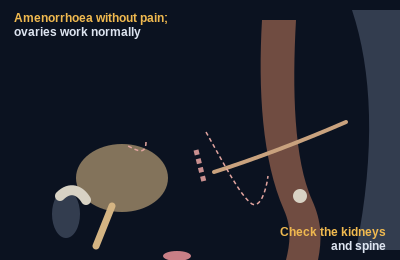
Make the diagnosis kindly
A girl with normal breast development and primary amenorrhoea without pain, with a short blind vaginal dimple, most likely has MRKH. Imaging shows absent uterus and normal ovaries; the karyotype is 46,XX. Check the kidneys and skeleton. Tell her and her family carefully and offer psychological support.
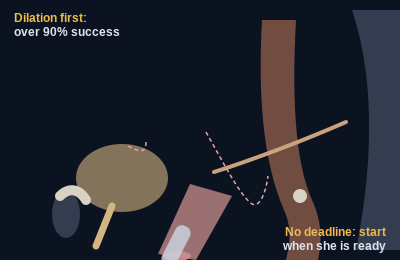
Dilation first
Graduated vaginal dilation stretches the dimple and succeeds in over 90%. There is no deadline: it starts when she is mature and ready. Teach the technique, increase size gradually, and review regularly.
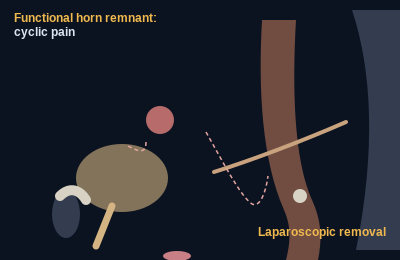
Remove a functional remnant
About 7 to 10% have a functional uterine horn remnant, usually lateral, causing cyclic pain. It is removed laparoscopically; a midline band of tissue between bladder and rectum is commonly seen.
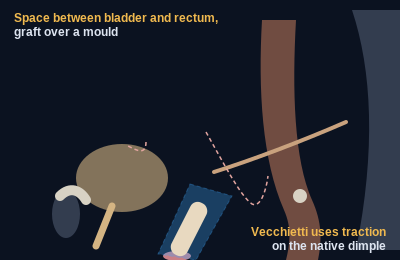
Surgery when dilation fails
A neovaginal space is made between the bladder and rectum and lined with graft tissue (skin, bowel, buccal mucosa, peritoneum or labial flaps) over a mould, as in the McIndoe operation. The Vecchietti operation instead stretches the native dimple quickly with laparoscopically placed traction.
Aftercare
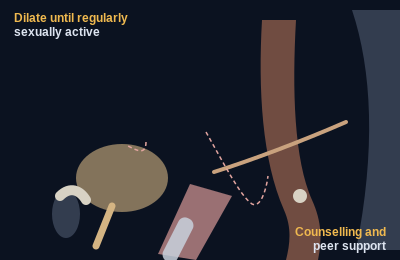
After a skin graft she stays recumbent about 7 days for the graft to take, wears the mould for 6 weeks, and dilates until regularly sexually active. Ongoing counselling and peer support help.
Indications
- Vaginal agenesis wanting a functional vagina: dilation first
- Surgical neovagina when dilation fails
- Functional uterine horn remnant with cyclic pain (7 to 10%)
Contraindications
- Surgery before a trial of dilation
- Starting before the young woman is ready and motivated
Consent: points to cover
- Diagnosis disclosed sensitively; infertility discussed (ovaries work; surrogacy or uterine transplant elsewhere)
- Dilation: time, privacy and commitment needed
- Surgery: graft failure, stenosis, need for long-term dilation, bladder or rectal injury; Vecchietti: iliac vessel injury
Equipment
- Graduated vaginal dilators
- For McIndoe: skin graft, mould, catheter
- For Vecchietti: traction device, laparoscope
Complications
- Neovaginal stenosis if dilation stops
- Fistula to bladder or rectum
- Graft failure; hair growth with some skin grafts
- Psychological distress
Exam pearls
- 46,XX, absent uterus and upper vagina, normal ovaries; amenorrhoea without pain
- 7 to 10% have a functional uterine horn remnant, often displaced laterally
- Dilation is initial treatment, over 90% successful; no critical age, depends on readiness
- Vecchietti: rapid stretching of the native dimple by traction; laparoscopic and vaginal; iliac vessel risk
- McIndoe: space between bladder and rectum lined with graft over a mould; 7 days recumbent, mould for 6 weeks, dilate until regularly sexually active