Ovarian cancer: staging and cytoreduction
A suspicious adnexal mass, judged by history, imaging and CA-125, should be referred to a gynaecological oncologist. Apparently early ovarian cancer needs comprehensive surgical staging, with intact removal of the mass. In advanced disease the aim is complete cytoreduction to no visible residual (or at worst 1 cm or less), which improves survival; neoadjuvant chemotherapy with interval surgery suits women unlikely to be optimally debulked.
Draft guide, awaiting specialist review. Check against your unit's protocol.
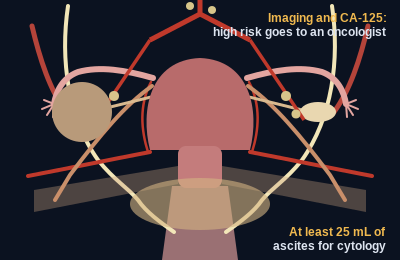
Fluid for cytology and inspection
Through an adequate incision, record the volume of ascites and send at least 25 mL for cytology; without ascites, take saline washings from the pelvis and gutters. Inspect all peritoneal surfaces, including the diaphragm and bowel.
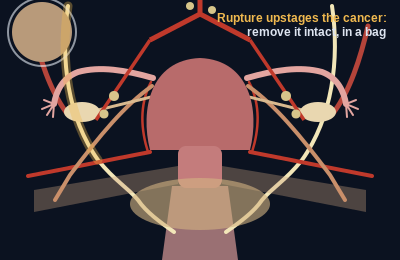
Remove the mass intact
Identify the ureter, then seal and divide the infundibulopelvic ligament and the utero-ovarian ligament, and remove the ovary whole, in a bag, without spill. Send it for frozen section; if malignant, complete the staging.
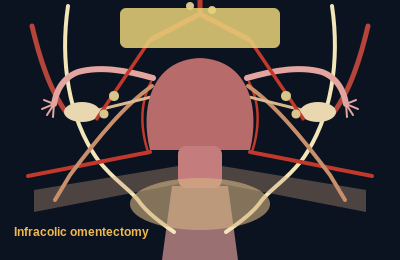
Infracolic omentectomy
For staging, remove the omentum below the transverse colon. In advanced disease with omental tumour, a supracolic omentectomy from hepatic to splenic flexure is performed.
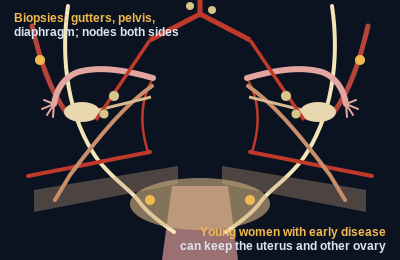
Nodes and peritoneal biopsies
Complete hysterectomy and the other adnexa (unless fertility is to be spared), bilateral pelvic and para-aortic lymph node dissection, and biopsies of both paracolic gutters, the pelvic peritoneum and the diaphragm. Many apparently early cancers are upstaged by this.
Cytoreduction in advanced disease
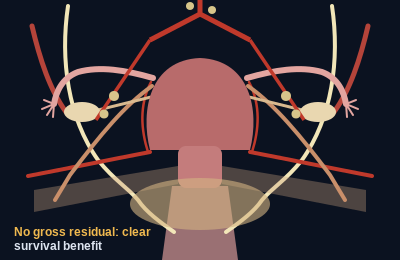
Through a full midline incision, remove all visible tumour where possible: hysterectomy and BSO, supracolic omentectomy, bowel resection, diaphragmatic stripping and, when needed, splenectomy. The goal is no gross residual (at worst 1 cm or less). Remove only bulky nodes. When complete resection looks unlikely, neoadjuvant chemotherapy and interval surgery is an alternative.
Indications
- Adnexal mass at high risk of malignancy
- Apparently early ovarian cancer: comprehensive staging
- Advanced disease: primary or interval cytoreduction
Contraindications
- Disease unlikely to be resected optimally, or a frail woman: neoadjuvant chemotherapy first
- Malignant bowel obstruction with extensive ascites and bulky tumour: medical management
Consent: points to cover
- Removal of uterus, tubes, ovaries and omentum; nodes and biopsies
- Bowel resection or stoma may be needed in advanced disease
- Fertility-sparing surgery possible for young women with early, non-disseminated disease
- Bleeding, infection, bowel, bladder or ureteric injury, thromboembolism
Equipment
- Midline laparotomy set, xiphisternum to pubis for advanced disease
- Specimen bag; frozen section
- Bowel staplers; vessel-sealing device
- Containers for ascites and washings
Complications
- Haemorrhage
- Bowel injury, anastomotic leak
- Ureteric injury
- Thromboembolism; wound infection
Exam pearls
- History, imaging and CA-125 identify the woman at high risk; refer to a gynaecological oncologist
- Early disease requires comprehensive staging; fertility-sparing surgery is possible for young women with early disease
- Remove the mass intact: rupture worsens the prognosis
- Staging: cytology, BSO and hysterectomy, infracolic omentectomy, pelvic and para-aortic nodes, peritoneal biopsies
- Advanced disease: aim for no gross residual, or at worst 1 cm or less
- Neoadjuvant chemotherapy with interval cytoreduction is an option
- In advanced disease, remove only bulky nodes