Positioning for pelvic surgery and preventing nerve injury
Most nerve injuries at gynaecological surgery come from positioning, stirrups, retractors, low transverse incisions or port sites and long operations, and many are preventable. Fewer than 2% of women are affected; most injuries are neurapraxias that recover within weeks. This guide covers safe lithotomy, the arms, steep head-down tilt, retractors and incisions, and what to do when a nerve injury is found after surgery.
Draft guide, awaiting specialist review. Check against your unit's protocol.
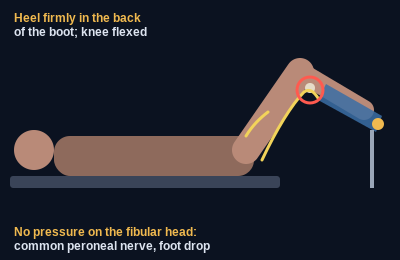
Legs in booted stirrups
Place the legs in the stirrups before induction if you can, lifting both together. Seat the heel firmly in the back of the boot so the weight is on the heel, not on the side of the calf. Flex the knee so the calf and thigh are 90 to 120 degrees apart, and check that nothing presses on the outside of the knee, where the common peroneal nerve winds round the fibular head.
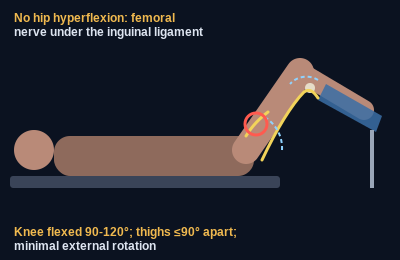
Hips: avoid the extremes
Avoid hyperflexion, wide abduction and external rotation of the hips: they compress the femoral nerve under the inguinal ligament and stretch the obturator and sciatic nerves. Keep the inner thighs no more than 90 degrees apart. Never combine a flexed hip with a straight knee, which stretches the sciatic nerve. Raise and lower both legs together, and stop assistants leaning on the thighs.
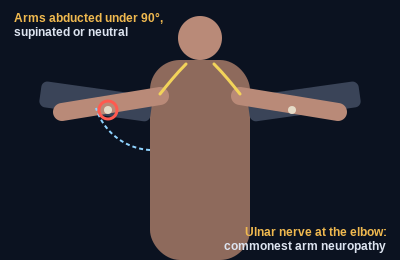
Arms: boards or tucked
On arm boards, abduct the arms less than 90 degrees, with the palms up or neutral. If the arms are tucked at the sides, keep the forearm and hand neutral (thumb up) and pad the elbow, because a supinated tucked arm presses the ulnar groove on the table. Do not let the elbow hyperextend off the board (median nerve) or the humerus press on a hard edge (radial nerve).
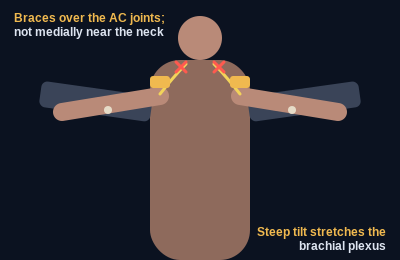
Steep head-down tilt
Steep head-down tilt lets the body slide towards the head and stretches the brachial plexus. Use a non-slip pad or beanbag; if shoulder braces are used, place them directly over the acromioclavicular joints, never medially near the neck. Keep the arms tucked or under 90 degrees, the head neutral, and the time in steep tilt as short as possible.
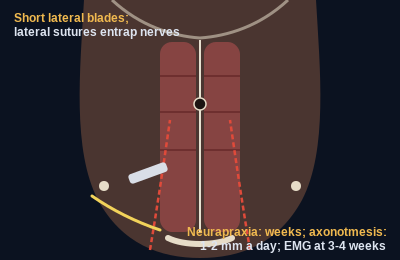
Retractors, incisions, and nerve injury after surgery
At laparotomy use the shortest lateral retractor blades that work, so they do not rest on psoas and the femoral nerve. Keep fascial sutures within the angle of a transverse incision or port site to avoid trapping the ilioinguinal and iliohypogastric nerves. In long cases briefly relieve stirrup and retractor pressure. If a nerve injury appears after surgery, examine power, sensation, reflexes and gait, start physiotherapy for motor loss, and request nerve studies only if there is no improvement by 3 to 4 weeks.
Indications
- Every gynaecological operation in lithotomy (vaginal, laparoscopic, robotic or combined)
- Laparoscopic or robotic surgery in steep head-down tilt
- Laparotomy with a self-retaining retractor or a low transverse incision
Contraindications
- Candy-cane stirrups for long cases or in women with hip or knee disease (booted stirrups give more support)
- Arm abduction over 90 degrees, pronated arms, or shoulder braces placed medially near the neck
- Long, deep lateral retractor blades resting on psoas, especially in thin women
Consent: points to cover
- Nerve injury from positioning is uncommon (under 2%), and most recover fully within weeks to months
- Foot drop, thigh weakness or numbness, groin or incision pain, or arm weakness are possible
- Longer operations in lithotomy carry a higher risk
Equipment
- Booted (Allen-type) stirrups that can be raised without undraping
- Arm boards or arm tucks with sheets, and pads for elbows and heels
- Non-slip pad or beanbag for steep head-down tilt; shoulder braces only if needed, over the acromioclavicular joints
- Retractor with a choice of short lateral blades
Complications
- Common peroneal nerve: foot drop, numb lateral leg and dorsum of foot (fibular head pressure, external rotation)
- Femoral nerve: weak hip flexion and knee extension, absent knee jerk (retractor blades on psoas, hip hyperflexion)
- Obturator nerve: weak adduction, medial thigh numbness, knee jerk kept (lymphadenectomy, hip flexion)
- Lateral femoral cutaneous nerve: burning anterolateral thigh (meralgia paraesthetica)
- Ilioinguinal and iliohypogastric entrapment: burning pain at the incision or port radiating to the labium
- Ulnar nerve (commonest arm injury), median, radial and brachial plexus injury
Exam pearls
- Position the legs before induction where possible, and lift both legs together
- Booted stirrups: heel firmly in the back of the boot; knee flexed 90 to 120 degrees; inner thighs no more than 90 degrees apart; minimal external rotation; nothing pressing on the fibular head
- Never a straight knee with a flexed hip (sciatic stretch); assistants must not lean on the thighs
- Arms on boards: under 90 degrees of abduction, palms up or neutral; tucked arms in neutral with padded elbows
- Steep tilt: non-slip pad, braces over the acromioclavicular joints, head neutral, shortest time possible
- Pressure of 80 mmHg stops nerve blood flow; in cases over 2 hours, briefly adjust stirrups and retractors
- Seddon: neurapraxia recovers in days to 6 weeks; axonotmesis regrows at 1 to 2 mm a day; neurotmesis needs repair
- Nerve conduction studies are not informative before 3 to 4 weeks