Postpartum tubal ligation: modified Pomeroy
Partial salpingectomy through a small infraumbilical incision after a vaginal delivery, or at caesarean section. A knuckle of mid-isthmic tube is tied with rapidly absorbable suture and the loop above the tie is excised. Postpartum partial salpingectomy is among the most effective tubal occlusion methods.
Draft guide, awaiting specialist review. Check against your unit's protocol.
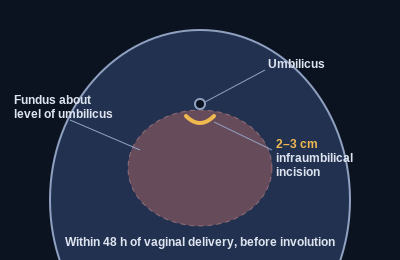
Position, timing and entry
Confirm consent and that mother and baby are well. Empty the bladder. Under regional or general anaesthesia, feel for the fundus, which lies near the umbilicus in the first 48 hours. Make a 2 to 3 cm incision just below the umbilicus, where the abdominal wall is thinnest, and open the peritoneum. Small retractors give the view.
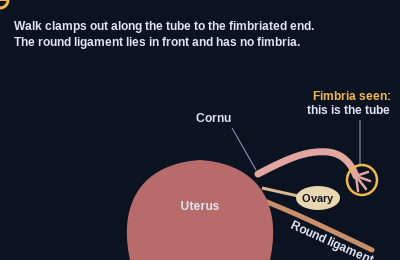
Find the tube and follow it to the fimbria
Sweep a finger over the fundus to the cornu and lift the tube into the wound. Walk Babcock clamps hand over hand along it until the fimbriated end is seen. Tilting the table towards the opposite side brings the tube up and lets bowel fall away.
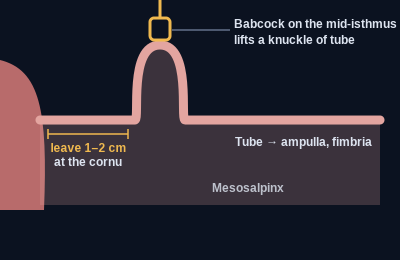
Lift a knuckle of mid-isthmus
Grasp the mid-isthmic portion with a Babcock clamp and lift it to form a loop, keeping 1 to 2 cm of tube between the loop and the cornu.
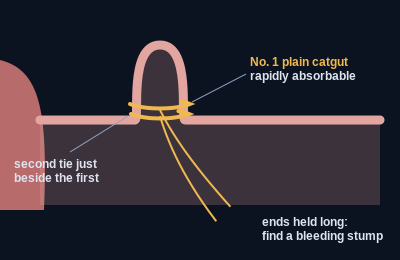
Tie the base of the loop
Tie the base of the loop with No. 1 plain catgut, then place a second tie just beside the first. Keep the ends long so the stumps can be found and held if they bleed.
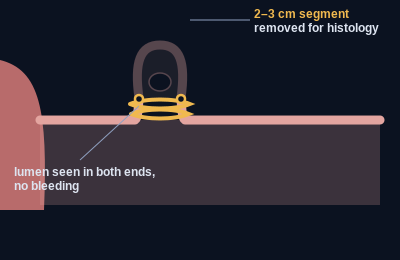
Excise the loop and inspect both ends
Make a small window in the mesosalpinx inside the loop. Cut off a 2 to 3 cm segment above the ties. Check that a lumen is visible in both cut ends and that neither bleeds. Put the segment in a labelled pot for histology.
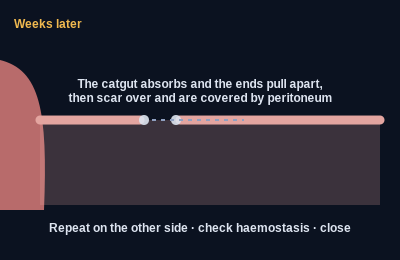
Other side, haemostasis and what happens next
Repeat on the other tube. Check haemostasis, close the fascia and skin, and record the method, both tubes identified by their fimbriae, and the specimens sent. Over the next weeks the catgut absorbs, and the cut ends pull apart, scar over and are covered by peritoneum. Follow up the histology.
Indications
- A woman who has decided on permanent contraception and gives informed consent, ideally counselled during antenatal care rather than in labour
- After a vaginal delivery: within 48 hours, before the uterus involutes
- At caesarean section, with consent confirmed again before the operation
Contraindications
- No informed consent, or consent that is uncertain or under pressure
- Mother or baby unwell: postpone if there is postpartum haemorrhage, sepsis, pre-eclampsia that is not controlled, or uncertainty about the baby's wellbeing
- Body habitus or adhesions that prevent the tubes being reached safely through a small incision: extend the incision or plan an interval laparoscopic procedure
Consent: points to cover
- The procedure is meant to be permanent; reversal is difficult, costly and may not restore fertility
- Alternatives with similar effectiveness: implant, intrauterine device, and vasectomy for her partner, which carries less risk
- Failure: about 7.5 pregnancies per 1,000 women at 10 years after postpartum partial salpingectomy
- A pregnancy after sterilisation is more likely to be ectopic: seek care early
- Risks: bleeding, infection, injury to bowel or bladder, the anaesthetic, and a larger incision if the tubes cannot be reached
- Regret is more common in women under 30 and after a change of partner
- South Africa (Sterilisation Act 44 of 1998): a woman aged 18 or over who can consent decides for herself; no partner's consent is needed. Consent may be withdrawn at any time before the operation
Equipment
- Small retractors (e.g. Langenbeck or Army-Navy)
- Babcock clamps (two or three)
- No. 1 plain catgut, or 0 chromic catgut
- Metzenbaum scissors and fine artery forceps
- Specimen pots for each tube, labelled left and right
Complications
- Bleeding from the mesosalpinx, or from a stump that slips out of its tie
- Inability to find or deliver the tube: extend the incision, tilt the table, or abandon and plan interval laparoscopy
- Ligation of the wrong structure (usually the round ligament)
- Wound infection
- Failure, with a raised proportion of ectopic pregnancies
Exam pearls
- Always see the fimbriated end before tying: it is the only way to be sure the structure is the tube
- Absorbable suture is essential: the cut ends must separate and fibrose; permanent suture holds them together and raises failure
- Leave 1 to 2 cm of tube at the cornu to reduce the risk of a tuboperitoneal fistula
- Send each segment for histology; a lumen on the report confirms the tube was divided
- Salpingectomy is the alternative if she wants it: it is more effective and may lower her risk of ovarian cancer