Repair of obstetric anal sphincter injury (OASIS)
Every perineal tear needs a rectal examination to find sphincter injury. Third- and fourth-degree tears are repaired in good light with good analgesia by an experienced operator, layer by layer: anal epithelium, internal sphincter, external sphincter, then the perineum as for a second-degree tear. Antibiotics, laxatives and early follow-up reduce complications.
Draft guide, awaiting specialist review. Check against your unit's protocol.
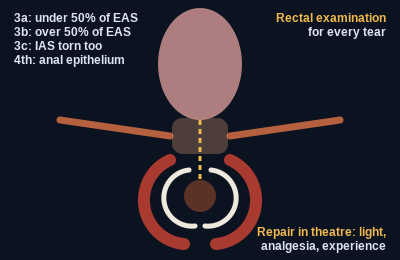
Examine and classify
After every tear, examine the vagina and perineum and do a rectal examination: with a finger in the anus and the thumb on the perineum, feel for the sphincter and look for a defect in the anal epithelium. Classify the tear. Move to theatre with good light, a retractor, an assistant and regional anaesthesia.
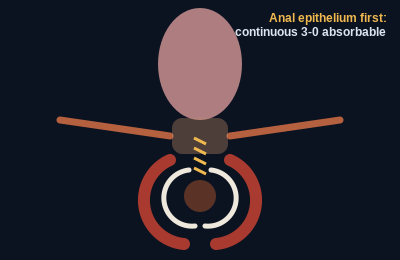
Repair the anal epithelium
For a fourth-degree tear, close the anal epithelium first with a continuous fine absorbable monofilament suture (2-0 or 3-0 poliglecaprone), starting above the apex.
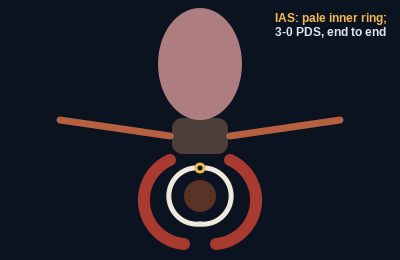
Repair the internal sphincter
Find the internal sphincter, a pale continuation of the circular muscle of the bowel lying inside the external sphincter and ending about 6 to 8 mm above the anal margin. Grasp the torn ends with Allis forceps and join them with 3-0 or 4-0 polydioxanone.
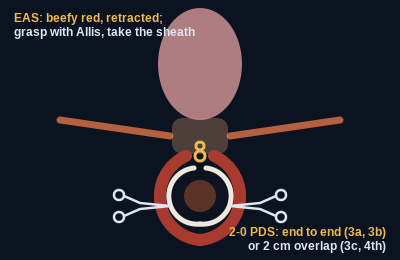
Repair the external sphincter
Find the retracted ends of the external sphincter, usually at 3 and 9 o'clock, grasp each with Allis forceps including the fascial sheath, and join them with 2-0 polydioxanone. For 3a and 3b tears, use end-to-end figure-of-8 sutures. For 3c and fourth-degree tears, an overlapping repair is an option: mobilise the ends from the ischiorectal fat to overlap by at least 2 cm, and use three or four mattress sutures.
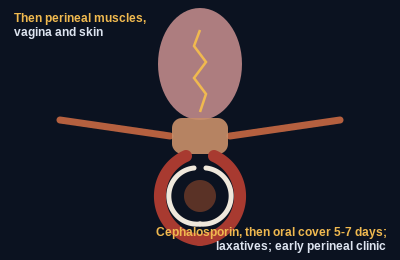
Perineum, vagina and aftercare
Repair the rest as a second-degree tear: vaginal mucosa with a continuous suture to the hymen, the perineal muscles to rebuild the perineal body, and the skin with a subcuticular suture. Irrigate well. Give an intravenous cephalosporin at repair and oral antibiotics (e.g. amoxicillin-clavulanate and metronidazole) for 5 to 7 days, laxatives, and arrange early review in a perineal clinic.
Indications
- Third-degree tear: 3a (under 50% of the external sphincter), 3b (over 50%), 3c (internal sphincter torn too)
- Fourth-degree tear: any third-degree tear with the anal epithelium torn
- Episiotomy extension into the sphincter, managed as a spontaneous tear
Contraindications
- Do not repair in poor light or without adequate analgesia: move to theatre
- Delay repair if the woman is unstable from haemorrhage; resuscitate first
Consent: points to cover
- What has torn and why repair matters for continence
- Repair in theatre under regional or general anaesthesia
- Antibiotics and laxatives afterwards; perineal hygiene; pelvic floor exercises
- Risks: infection (about 20%) and wound breakdown (about 25%), anal incontinence (flatus more often than stool), rarely rectovaginal fistula
- Follow-up in a perineal clinic; a later birth plan to discuss
Equipment
- Theatre lighting, regional anaesthesia, a retractor and an assistant
- 3-0 poliglecaprone or polyglactin for the anal epithelium
- 3-0 or 4-0 polydioxanone (PDS) for the internal sphincter; 2-0 PDS for the external sphincter
- Allis forceps; 2-0 rapidly absorbable polyglactin for vagina and perineal muscles; 3-0 or 4-0 for skin
Complications
- Wound infection and breakdown
- Anal incontinence (mean about 35%) and faecal incontinence (about 10%)
- Rectovaginal fistula (0.4 to 3% after fourth-degree tears)
- Haematoma, pain and dyspareunia
Exam pearls
- A rectal examination after every tear is the only way not to miss a sphincter injury
- Repair order: anal epithelium, internal sphincter, external sphincter, then perineum, vagina and skin
- The internal sphincter is pale, the external sphincter beefy red and usually retracted to 3 and 9 o'clock
- End-to-end and overlapping repairs give similar outcomes; overlap needs at least 2 cm of mobilised sphincter
- Use delayed absorbable suture (PDS) for the sphincters and include the fascial sheath
- Mediolateral rather than midline episiotomy lowers sphincter injury; forceps carries the highest risk
- Repair a broken-down wound early once infection has cleared