Surgery for tubo-ovarian abscess
Most PID is treated with antibiotics alone. A tubo-ovarian abscess needs admission and intravenous antibiotics, with drainage or surgery when the woman does not improve within 48 to 72 hours, is septic, or the abscess is very large. Surgery in acute infection is difficult: tissues are oedematous and friable, so start in the retroperitoneum away from the abscess and keep fertility in mind.
Draft guide, awaiting specialist review. Check against your unit's protocol.
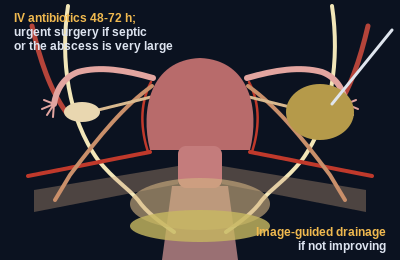
Antibiotics first; drain if needed
Admit a woman with a tubo-ovarian abscess and start parenteral antibiotics: a cephalosporin with doxycycline, adding metronidazole or clindamycin for anaerobes. Treat partners. If she is not septic and the abscess is not very large, give 48 to 72 hours before deciding on drainage. Image-guided percutaneous drainage succeeds in many and may avoid surgery.
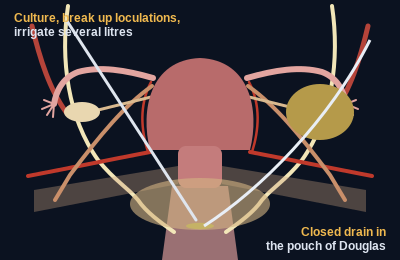
Laparoscopic drainage
Look at the whole pelvis, the upper abdomen and the appendix. Take cultures from pelvic fluid and the fimbriae. Break up loculations with the suction-irrigator, irrigate with several litres of saline or Ringer's lactate, and leave a closed-suction drain in the pouch of Douglas, brought out through a lower port site.
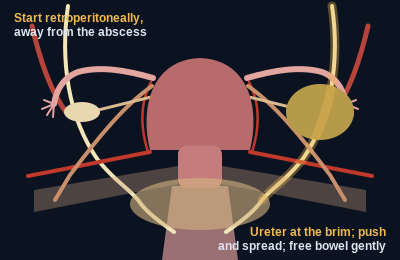
Start in the retroperitoneum
For an open or extirpative operation, use a vertical midline incision. Open the retroperitoneal spaces away from the abscess, find the ureter where it crosses the iliac bifurcation and follow it with push-and-spread while retracting the adnexa medially. Free adherent bowel gently.
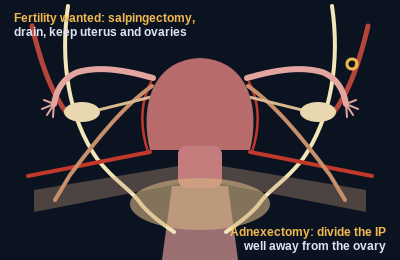
Remove the abscess
If fertility is wanted, the damaged tube is removed with drainage of the abscess, keeping the uterus and ovaries. For adnexectomy, open the peritoneum lateral to the IP ligament, make a window in the posterior broad ligament, and divide the IP ligament well away from the ovary with the ureter in view. In severe disease hysterectomy and bilateral salpingo-oophorectomy may be needed, ligating the uterine artery at its origin.
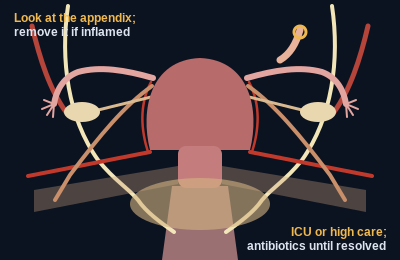
Appendix, bowel and aftercare
Inspect the appendix and remove it if it is inflamed. Repair bowel deserosalisation involving the muscularis with fine delayed absorbable sutures; close full-thickness injuries in two layers, and resect if more than a third of the circumference is involved. Leave a drain if needed. Plan ICU or high care, continue broad-spectrum antibiotics until the infection resolves, and give 14 days of oral antibiotics after fertility-sparing surgery.
Indications
- Tubo-ovarian abscess not improving after 48 to 72 hours of parenteral antibiotics
- Sepsis, suspected rupture or a very large abscess (urgent surgery)
- Diagnostic uncertainty (e.g. appendicitis cannot be excluded); drainage not available or not feasible
Contraindications
- Uncomplicated PID: antibiotics, not surgery
- Elective surgery for a resolving abscess should wait 2 to 3 months
Consent: points to cover
- Drainage, salpingectomy, adnexectomy, and possibly hysterectomy and bilateral salpingo-oophorectomy in severe disease
- Fertility: the affected tube is usually beyond saving; the aim is to keep the uterus and ovaries
- Risks: bowel injury, ureteric and bladder injury, bleeding, wound infection, ICU care
- Appendicectomy if the appendix is involved
Equipment
- Broad-spectrum intravenous antibiotics (cephalosporin plus doxycycline, with metronidazole or clindamycin for an abscess)
- Laparoscopy with a 10 mm suction-irrigator, or a laparotomy set (vertical midline for severe disease)
- Closed-suction drain; specimen and culture containers
- General surgeon available for bowel
Complications
- Septic shock; ruptured abscess (mortality 5 to 10% if treatment is delayed)
- Bowel injury, deserosalisation and enterotomy
- Ureteric injury; ovarian remnant
- Wound infection, vault breakdown, ileus and thromboembolism
Exam pearls
- PID is polymicrobial; treat with broad-spectrum antibiotics and treat partners
- Outpatient: ceftriaxone IM plus doxycycline 14 days, with metronidazole; avoid fluoroquinolone-only regimens
- Admit for an abscess, pregnancy, severe illness, failure of oral treatment, inability to take it, or when a surgical emergency cannot be excluded
- An IUD can stay in; consider removal if there is no improvement in 48 to 72 hours
- Start retroperitoneally away from the abscess and find the ureter at the brim
- Unilateral salpingectomy with drainage is preferred for stable women who want fertility
- Surgery for sequelae should wait 2 to 3 months after the infection settles