Transverse vaginal septum and lower vaginal atresia
A transverse vaginal septum (about 1 in 72,000) or lower vaginal atresia blocks menstrual flow and presents at puberty with amenorrhoea and pain. MRI shows the level, the distance from the perineum and the thickness. The septum is entered over a needle that has found the blood behind it, excised, and the upper and lower vagina joined with interrupted sutures; thick septa need a Z-plasty. A mould or dilators prevent stenosis.
Draft guide, awaiting specialist review. Check against your unit's protocol.
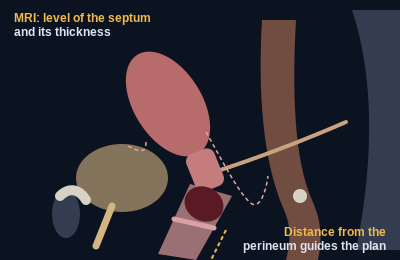
Define the obstruction
An adolescent with primary amenorrhoea and cyclic pain, with a short vagina or a dimple and no bluish bulge, may have a transverse septum or lower vaginal atresia. MRI shows the level, the thickness and the distance from the perineum, which decide the operation.
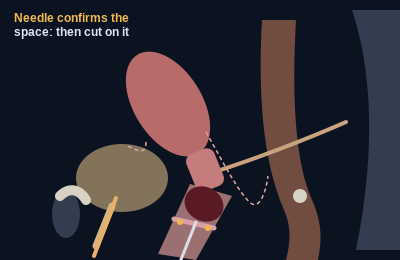
Find the space with a needle
Catheterise the urethra. Place stay sutures in all four quadrants of the septum and, with them on tension, pass an 18 G spinal needle through its centre until old blood is aspirated, confirming the space.
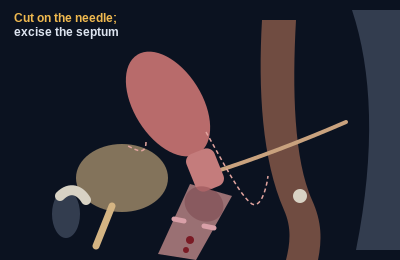
Open, drain and excise
Cut down on the needle transversely with a scalpel, extend the opening laterally with a clamp, and drain the collection. Grasp the edges of the septum and excise it, with cut-and-tie or diathermy for a thin septum.
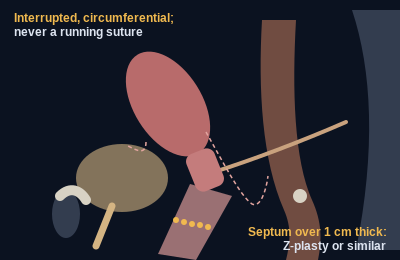
Join with interrupted sutures
Join the upper vagina to the lower vagina with serial interrupted absorbable sutures all the way round. A septum more than 1 cm thick is better repaired with a Z-plasty, Y-plasty or cross-plasty, which uses the septal mucosa to lengthen and widen the vagina.
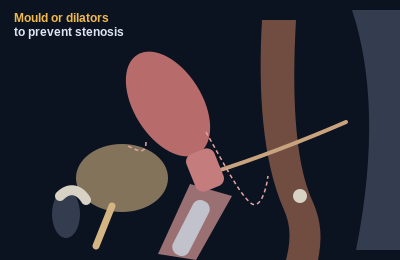
Mould and lower vaginal atresia
Place a vaginal mould or start dilators to keep the anastomosis open. For lower vaginal atresia with a gap of 3 cm or less, a pull-through is done: stay sutures on the dimple, a spinal needle finds the haematocolpos, the atretic segment is removed and the vaginal mucosa pulled down and sewn to the perineum with interrupted sutures.
Indications
- Obstructing transverse vaginal septum with haematocolpos
- Lower vaginal atresia (pull-through when the gap is 3 cm or less)
- Non-obstructing septum causing dyspareunia or difficulty with tampons
Contraindications
- Long gap or high atresia: preoperative dilation or a graft may be needed; refer to an experienced centre
- Operating without imaging of the level and thickness
Consent: points to cover
- Risk of stenosis and need for a mould or dilators
- Bladder or bowel injury
- Further surgery if narrowing recurs
- Effect on menstruation, fertility and sexual function explained to the girl and her family
Equipment
- MRI beforehand
- Foley catheter, stay sutures, 18 G spinal needle
- Absorbable sutures (interrupted)
- Vaginal mould or dilators
Complications
- Vaginal stenosis (especially with running sutures)
- Bladder or rectal injury
- Infection of the drained collection
- Recurrent obstruction
Exam pearls
- Obstructive anomalies typically present at puberty; lack of menses with pain suggests outflow obstruction
- Upper and mid-vaginal septa are the commonest and hardest to repair
- Stay sutures in four quadrants; a spinal needle confirms the space before cutting
- Join upper and lower vagina with interrupted circumferential sutures; running sutures cause stricture
- Septum over 1 cm thick: Z-plasty, Y-plasty or cross-plasty
- Lower vaginal atresia shows a dimple without the bluish bulge of an imperforate hymen