Using electrosurgery safely
Almost every gynaecological operation uses electrosurgery, and its injuries, reported in 2 to 5 per 1,000 cases, often present days later. Safe use rests on a few physical rules: current must complete a circuit, follows the path of least resistance, and its effect depends on current density, waveform, contact and time. This guide covers the monopolar circuit and return pad, CUT and COAG, bipolar and sealing devices, stray energy in laparoscopy, and recognising thermal injury.
Draft guide, awaiting specialist review. Check against your unit's protocol.
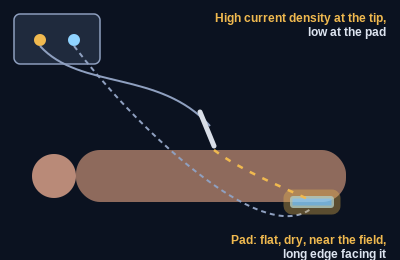
The monopolar circuit and the return pad
In monopolar surgery the current enters at the small active tip, where its density causes the tissue effect, spreads through the body and leaves through the large dispersive pad, where density is too low to burn. Place the pad on dry, well-perfused skin over muscle, close to the operative field, with its long edge facing the field, and use return electrode monitoring. Remove piercings near the field or tape them flat; keep the current path away from any cardiac device.
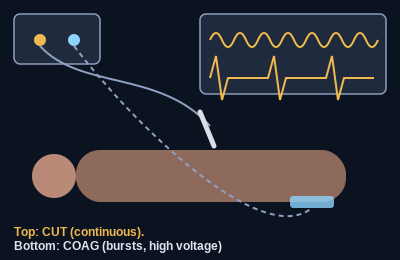
Choose the waveform and technique
CUT is a continuous low-voltage wave: held just off the tissue with a thin electrode, it vaporises cells and cuts with little coagulation. COAG is interrupted, on only about 6% of the time, with a high peak voltage: held off the tissue it sprays sparks and fulgurates the surface; in contact it desiccates more deeply. In BLEND, the power comes from the CUT setting. A smaller electrode raises current density; a dry field works better than a pool of blood.
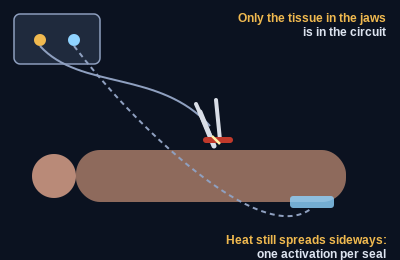
Bipolar and vessel sealing
In bipolar devices both electrodes sit in the jaws, so only the tissue between them is in the circuit. Desiccate with the continuous (CUT) waveform and stop when steam stops and the tissue turns white. Advanced bipolar sealers and ultrasonic shears seal vessels up to 7 mm using pressure, heat and time, then divide them. Heat still spreads sideways, and ultrasonic jaws stay hot for several seconds after use.
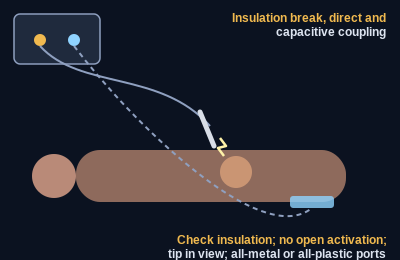
Stray energy in laparoscopy
Less than 15% of the abdomen is in view, so stray energy injuries are often missed. Insulation failure lets current leak through a crack in the shaft. Direct coupling happens when the active electrode touches another instrument or the laparoscope. Capacitive coupling induces current in a nearby conductor through intact insulation, worst with COAG, hybrid metal-and-plastic ports, operative laparoscopes and metal suction-irrigators. Inspect insulation, avoid open activation, keep the tip in view, use the lowest power and CUT where possible, and use all-metal or all-plastic ports or active electrode monitoring.
Recognise and treat thermal injury
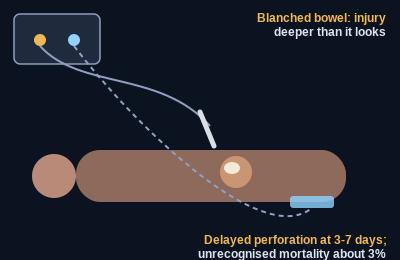
A pale, blanched area on bowel after electrosurgery means the injury is deeper than it looks; repair with a margin of healthy tissue or resect, with a bowel surgeon if needed. Electrosurgical injuries often present 3 to 7 days after surgery with pain, fever and peritonitis, so take any woman who is not progressing after laparoscopy seriously. At monopolar hysteroscopy, activate the loop only while drawing it towards the scope; if an active electrode perforates the uterus, inspect the abdomen by laparoscopy.
Indications
- Monopolar cutting and coagulation at open, laparoscopic and hysteroscopic surgery
- Bipolar desiccation and vessel sealing (up to 7 mm with advanced sealers)
- Ultrasonic and laser energy as alternatives where lateral spread or depth matters
Contraindications
- Open activation (energising before touching tissue) in the abdomen
- Monopolar energy close to bowel, bladder or ureter when a bipolar, ultrasonic or sharp alternative will do
- Monopolar hysteroscopic resection in saline (it needs a non-conducting fluid such as glycine)
Consent: points to cover
- Thermal injury to bowel, bladder or ureter, which may present days later
- Skin burns (return pad, jewellery, drapes) and, rarely, operating room fire
- Interference with a pacemaker or defibrillator (plan with cardiology)
Equipment
- Generator with return electrode monitoring; correct-size dispersive pad
- Inspected laparoscopic instruments with intact insulation; active electrode monitoring if available
- All-metal or all-plastic ports (avoid hybrids)
- Bipolar forceps, advanced bipolar sealer or ultrasonic shears; smoke evacuation
- Holster for the pen when not in use
Complications
- Return pad burns when the pad lifts or is badly placed
- Direct coupling, insulation failure and capacitive coupling burns, often out of view
- Bowel thermal injury with delayed perforation (unrecognised injury mortality about 3%)
- Lateral thermal spread from bipolar and ultrasonic devices; ultrasonic jaws stay hot after use
- Hysteroscopic perforation by an active electrode; vulval or vaginal burns from the resectoscope sheath
Exam pearls
- Monopolar: high current density at the small active tip gives the effect; the large pad disperses it
- Pad: dry, flat, on well-perfused tissue near the field, long edge facing the field, with return electrode monitoring
- CUT: continuous, low voltage; non-contact use vaporises (cuts). COAG: about 6% on, high peak voltage; non-contact fulgurates, contact desiccates
- BLEND power comes from the CUT setting
- Smaller electrode, higher current density; keep the tissue dry; use the lowest effective power
- Bipolar: only the tissue between the jaws is in the circuit; stop when steam stops and tissue whitens; one activation per seal
- Stray energy: insulation failure, direct coupling, capacitive coupling (worst with COAG, hybrid ports, operative laparoscopes, metal suction-irrigators)
- Blanched bowel: injury is deeper than it looks; repair or resect with a margin
- Hysteroscopy: activate only while drawing the electrode back towards the scope